


Nature - 2019 February - Vol 566 No 7745
Publisher: Nature
Format: Paperback
ISBN: 9770028083095
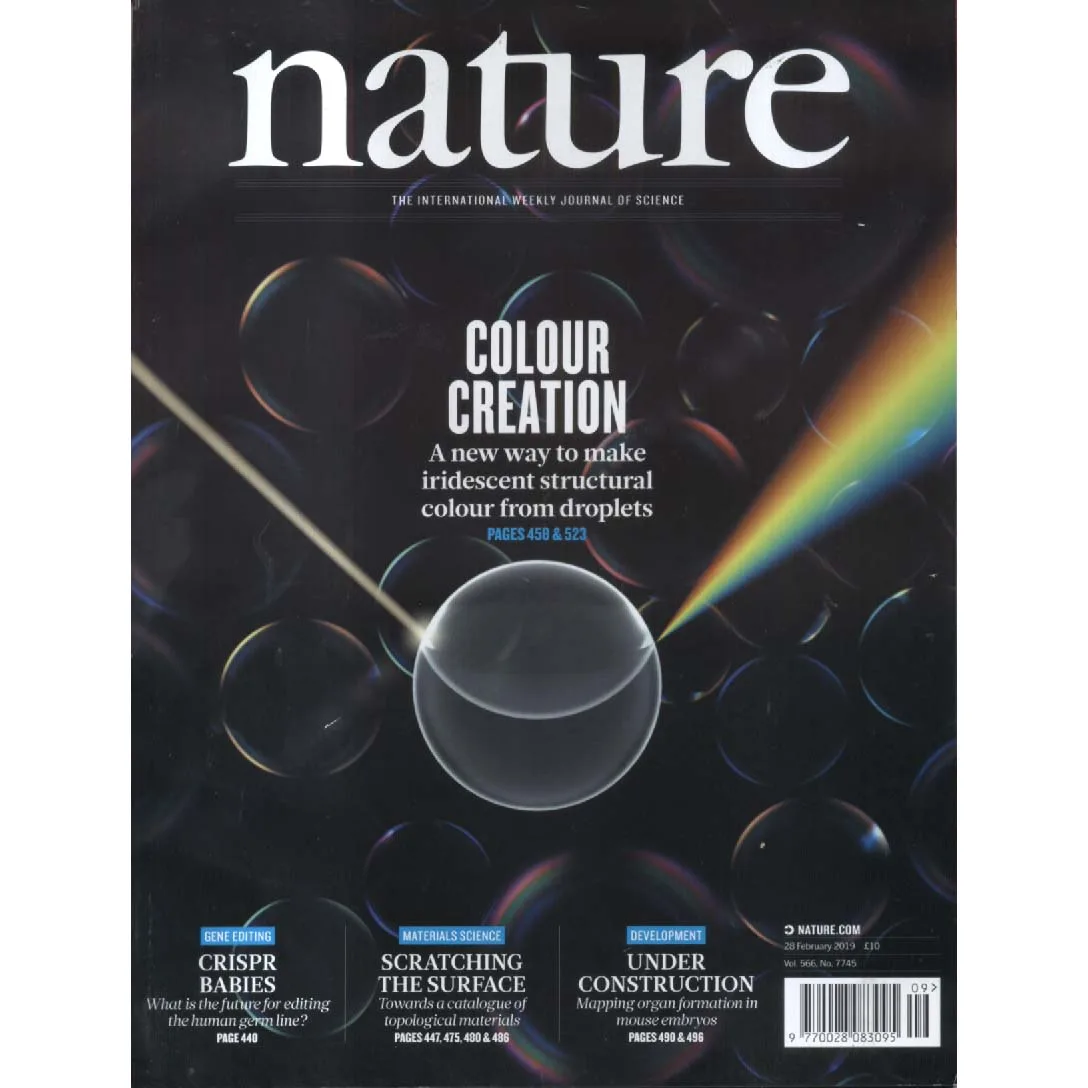
There are few publications on Earth capable of placing the words “CRISPR BABIES” on the front cover without immediately descending into tabloid hysteria. Nature – February 2019, Vol. 566 No. 7745 manages it with immaculate composure, calmly surrounding the ethical future of human gene editing with shimmering droplets and elegant typography as though civilisation itself is not quietly wandering into uncharted territory.
The main cover feature, “COLOUR CREATION”, concerns a new way of producing iridescent structural colour from droplets. Which is already delightfully futuristic. Somewhere in these pages scientists are manipulating light and matter to manufacture colour itself, proving once again that modern materials science increasingly resembles alchemy conducted by people with excellent grant funding.
The cover artwork is beautiful in that distinctly Nature way — dark, glossy, vaguely cosmic, and suggestive of either a breakthrough in optics or the birth of a very expensive perfume brand. Tiny glowing spheres float in darkness while rainbow light refracts across the page, making the entire issue look less like a weekly science journal and more like an artefact recovered from an advanced civilisation that solved physics centuries ago.
And then, quietly tucked in the lower corner, comes “CRISPR BABIES”. Four syllables capable of causing an entire ethics conference to collapse into panicked debate. It is a reminder of just how extraordinary 2019 already was scientifically: humanity had reached the point where editing the human germ line was no longer theoretical science fiction but an active global argument. Naturally, Nature addresses this with the same measured tone it uses for discussing mouse embryo development and topological material defects.
Elsewhere inside, scientists are “scratching the surface” of material flaws, mapping organ formation in embryos, and continuing the grand human tradition of discovering that biology is vastly more complicated than anticipated. Every article feels like another small step toward a future simultaneously miraculous and slightly concerning.
That is the enduring magic of Nature: it documents world-changing discoveries with complete emotional restraint. “What is the future for editing the human germ line?” it asks politely, as though discussing garden landscaping options rather than one of the largest ethical questions in human history. There is something wonderfully British about the understatement of it all.
Owning a copy of Nature also creates a particular atmosphere. It implies serious intellectual engagement and the possibility that you occasionally think about structural colour formation while making tea. Whether you actually read the dense multi-page article on embryonic organ mapping or simply admired the cover while feeling gently overwhelmed is largely irrelevant. The magazine functions equally well as scientific literature and aspirational décor.
This February 2019 issue now feels especially evocative of the late-2010s scientific mood — a period where advances in gene editing, materials science, and developmental biology were arriving so rapidly that the future began to feel oddly close. Reading it today carries the sense of standing at the edge of several enormous technological shifts all happening at once.
Condition is listed as Good, meaning this copy has survived the usual hazards associated with elite scientific journals: overfilled messenger bags, desks belonging to exhausted researchers, coffee consumed near highly important diagrams, and years spent in a stack labelled “essential reading” that somehow kept growing taller.
An outstanding issue for science enthusiasts, futurists, biology obsessives, or anyone who enjoys magazines that casually place human gene editing and rainbow optical engineering side by side without missing a beat.
Keep browsing: See more Nature Journal books Other books by Nature
